Structural Drying and Dehumidification in Chelsea, MA
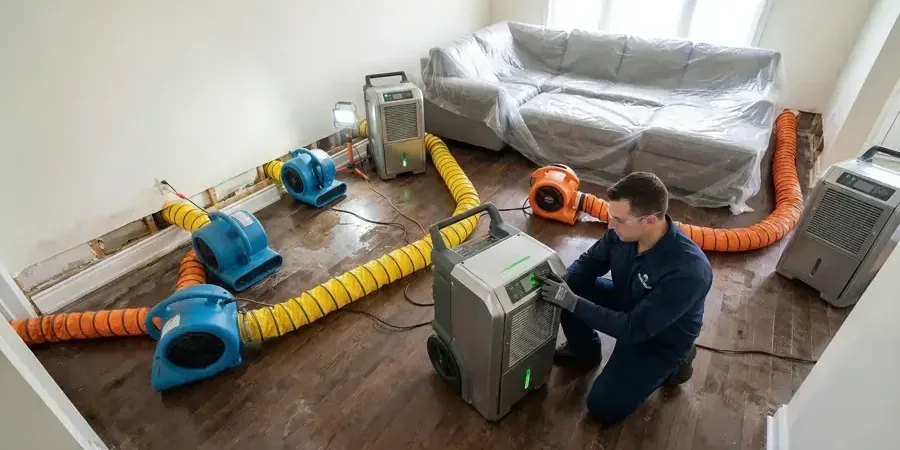
After the water is extracted, the drying team sets air movers, LGR dehumidifiers and heat where needed, then reads plaster, framing, subfloor and masonry every day until they match a dry reference.
(888) 629-3140Walls still wet after a leak? Start structural drying- LGR dehumidification
- Daily psychrometric logs
- 2 to 4 points of dry
What to do first about structural drying and dehumidification
Do only what feels safe. Water near an outlet, a sewage smell or a sagging ceiling means stepping back and calling first.
- 1
Stop the water
Close the source so the structure is not re-wetted.
- 2
Get standing water out
Extraction comes before any drying equipment.
- 3
Keep the heat steady
Hold indoor temperature in a normal range in winter.
- 4
Leave equipment running
Air movers and dehumidifiers must run day and night.
What does structural drying and dehumidification cost in Chelsea, MA?
Structural drying in Chelsea typically costs $1,500 to $10,000, depending on how many rooms and units are wet, the materials involved and how many days the equipment runs. Plaster and masonry usually add days.
Ranges are typical, not a quote: the category of water, square footage, material class and how fast drying started move the number most. The water damage cost calculator narrows it; the moisture map on the walkthrough decides it.
How structural drying and dehumidification is handled, step by step
Map
Moisture map and dry reference.
Set
Equipment sized to the class of loss.
Log
Daily psychrometric readings.
Verify
Dry within 2 to 4 points.
The four stops of every structural drying and dehumidification dry-out
- 1
Trace and measure
A thermal camera and a pinless meter show how far the water travelled before a single fan is placed.
- 2
Pull the water out
Truck-mounted extraction empties floors and carpet pad first, because every gallon left behind adds drying days.
- 3
Move the air, pull the humidity
Air movers push moisture out of plaster, framing and subfloor, and LGR dehumidifiers take it out of the room air.
- 4
Read it dry, then log it
Daily readings are compared with an unaffected room, and drying stops when the numbers sit within 2 to 4 points.
Structural drying is the part of a water job that decides whether walls and floors are truly dry or only look dry. In Chelsea, where about half of the homes were built in 1939 or earlier, that often means plaster over wood lath, old-growth framing and masonry foundations, which hold water differently than modern drywall.
How the drying plan is built
- A moisture map marks every wet surface and its readings
- The class of loss sets how many air movers and dehumidifiers go in
- A dry reference reading is taken from an unaffected wall or floor
- Daily psychrometric logs track temperature, humidity and grains per pound
Old materials need a different approach
Plaster and masonry release water slowly and can be damaged by aggressive heat. The drying team uses LGR or desiccant dehumidifiers, directed air and, in cold buildings, controlled heat, then reads the material daily. Equipment stays until the readings sit within 2 to 4 points of the dry reference.
Why dry air matters
Damp structures affect indoor air quality, and mold growth can start within 24 to 48 hours. If the power is out, Ready.gov power outage tips apply. The drying-time estimator gives a rough timeline.
Structural drying and dehumidification across Chelsea, MA
The restoration team covers ZIP 02150 from Bellingham Square out to Admirals Hill, Mill Hill, Prattville, the Box District, Addison-Orange and the low streets along the creek and the Island End River.
Nearby coverage reaches East Boston, Everett, Charlestown, Winthrop, Malden, Revere.
Related water damage services
Structural Drying and Dehumidification questions in Chelsea, MA
Still dealing with it?
Floors and walls still reading wet? The drying team works 24/7.
Get the drying plan setWhat does dry mean in structural drying?
Dry means the material reads within 2 to 4 points of the same material in an unaffected part of the building, measured with a meter, not judged by touch.
Why do air movers and dehumidifiers run all day and night?
Drying is continuous. Turning equipment off at night lets humidity climb back up and adds days to the job.
Can plaster walls be dried in place?
Often, if the plaster is still keyed to the lath. Readings and a pull check decide whether it stays or comes out.
How is the drying equipment sized?
By the class of loss and the size of each room, following the IICRC S500 standard. More water in more porous material calls for more equipment.
How long does structural drying take?
Three to seven days for most jobs. Masonry, hardwood and cold buildings take longer, and the readings, not the calendar, end the job.
Leak fixed but the walls are still wet? Get them dried to standard.
Looking dry is not the same as reading dry. The drying team meters and logs until the structure is.
(888) 629-3140Book structural drying today