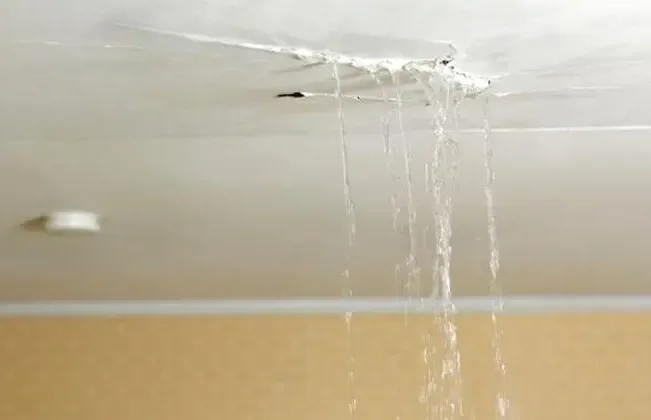
In Malden, 5,987 housing units sit in 2-unit buildings and 3,380 in 3-or-4-unit buildings, so a ceiling stain often has another household's floor above it. The first decisions matter most: stop the water, keep people clear, and make sure the ceiling does not come down on its own.
Key takeaways
- Malden has 5,987 housing units in 2-unit buildings and 3,380 in 3-or-4-unit buildings, so many ceilings sit under another household.
- A bulging or dripping ceiling is holding water and can fail without warning, so people stay out from under it.
- The source can be a supply pipe, a drain, a tub or toilet overflow, or an appliance hose upstairs.
- Wet insulation and joist bays are opened and dried, because paint over a stain leaves the moisture behind.
- With about 59 percent of occupied homes rented, the owner, the tenant above and the tenant below all need to hear what is happening.
Why so many ceilings sit under another household
Malden counts 27,876 housing units, and the median year its homes were built is 1950. About 12,572 of them, roughly 45 percent, date to 1939 or earlier.
Of the 26,042 occupied homes, about 15,298 are rented. In a building with a unit above, a ceiling leak often involves more than one household.
The housing mix matters too. Malden has 6,622 single-family detached homes and 2,041 single-family attached homes, next to the 2-unit and 3-or-4-unit buildings.
A leak in a detached home starts in the same household that feels it, which makes the stacked-unit case a different kind of problem.
First steps when water appears
A ceiling that sags or bulges is holding water. Draining it is a job for a trained team, because a heavy ceiling can drop all at once.
A rushed attempt at relieving the water can bring wet plaster or drywall down on whoever is standing below.
- Move people and belongings away from the area under the stain or bulge.
- Switch off ceiling lights and fans in the area, and keep the wet circuit off at the panel.
- Set a bucket under a drip, and move furniture and electronics out of the way.
- Photograph the stain, the drip and the ceiling before anything changes.
- Contact the household above, or the owner or manager, so the water is shut off at the source.
Finding where the water comes from
The pattern of the stain gives clues, and the household above can confirm the cause.
In some cases the source is not an interior pipe at all. A roof leak, a window leak or a heating pipe can produce the same stain, and moisture readings help sort them out.
Supply pipes
A pressurized pipe leaks all day and all night, so the stain keeps growing even when nobody is using water. This type often pours into the joist bay and spreads in several directions.
Drains and fixtures
A drain or fixture leak shows up after use. A stain that grows after a shower, a flushed toilet or a drained tub points to a drain, a seal or an overflow upstairs.
Appliances
A stain that appears during a wash cycle or after the dishwasher runs points to a hose or a fitting. The appliance leak cleanup work starts where the appliance sits and follows the water down.
Opening the ceiling
Opening a ceiling is not the first step. It is the step that makes sense once readings show water inside, and a ceiling leak water damage team cuts access holes to let trapped water out and to see the joist bay.
Wet insulation is removed because it holds water against the wood. Older ceilings can be plaster rather than drywall, and plaster needs different handling, so the type is checked before any cut.
A small inspection hole is sometimes enough to confirm what is behind the stain. If the cavity is wet, the opening grows to the size needed for drying.
- Soaked insulation is bagged and removed.
- Joists and subfloor are checked with a moisture meter.
- Cut edges are kept clean so the repair goes quickly.
What happens when a wet ceiling is left alone
Water that sits in a joist bay keeps soaking insulation and wood. A ceiling that started as a small stain can turn into a sagging one.
Wet materials left in place can also support mold growth, which adds a second repair to the first.
- The stain spreads and darkens.
- Paint blisters and peels.
- Plaster or drywall softens and sags.
- Insulation compresses and holds water against the framing.
Drying the joist bay and the floor above
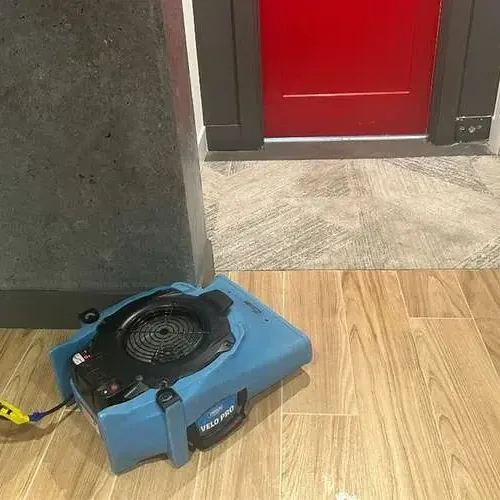
Structural drying pushes dry air through the opened bay. Dehumidifiers pull moisture out of the room, while small air movers keep air flowing over wet wood.
The unit above often needs a look too. The floor under the source may be wet even when the stain appears downstairs.
Drying does not end when the surface feels dry. The bay is closed only after readings in the wood match a dry reference.
- Readings are taken in the joists, the subfloor and the walls on both levels.
- Equipment is placed so air reaches the opened bay.
- Drying stops only when readings match a dry reference.
Who does what between households
Because a leak crosses household boundaries, three people each have a job: the one with the leak, the one with the stain and the owner. Clear, written updates keep the work moving.
Written updates matter because memory fades and responsibility shifts. A short text or email after each visit, with photographs attached, builds a record that helps everyone.
For the other situations that come up in local buildings, the Malden water damage pages list the services.
Insurance questions come later. Photographs, readings and a written note on the source are what the households involved will need.
- The household above shuts off the water and stops using the fixture.
- The household below photographs the damage and stays out from under the ceiling.
- The owner or manager arranges access, the plumber and the drying team.
Questions
Is a brown ceiling stain a sign of an old leak or a new one?
A stain with a dark ring and a damp center is usually current. A dry stain with crisp edges is often old. A moisture meter settles the question.
Can a ceiling stain just be painted over?
Not safely. Paint seals the surface but leaves wet insulation and framing behind, and the stain returns when the moisture reaches the paint again.
Who pays for the ceiling when the leak comes from another unit?
That depends on the lease, the building's insurance and the policies involved, so the owner or manager and the insurers sort it out. A restoration team documents the damage and the source.
What if the water comes from the roof instead of a unit above?
A stain on a top floor ceiling or near an outside wall can come from the roof. The trace then runs from the attic down instead of from a unit above.
Do light fixtures in a wet ceiling need attention?
Yes. Water in a fixture is a shock risk, so the circuit stays off at the panel until the ceiling is opened and dry.
How long does a wet ceiling take to dry?
It depends on how long the water ran and what the ceiling holds. A moisture meter, not a guess, shows when the wood is done.